

In Loving Memory
Howard Archibald Goss
"Heavily influenced by evangelist Charles Fox Parham, Howard Archibald Goss abandoned his early religious skepticism and dedicated his life to spreading the Pentecostal movement across North America. A…"
Life Story
Honoring Their Path
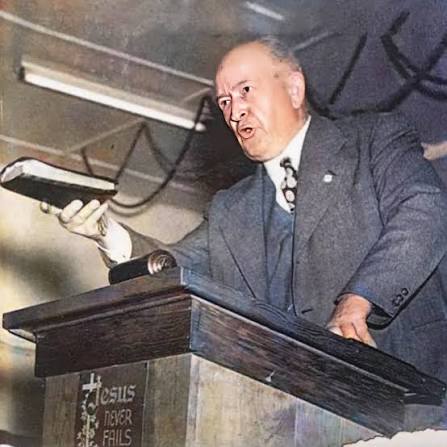
Heavily influenced by evangelist Charles Fox Parham, Howard Archibald Goss abandoned his early religious skepticism and dedicated his life to spreading the Pentecostal movement across North America. After studying at Parham's Bible school and launching widespread revivals, Goss helped bring scattered congregations together by co-founding the "Assemblies of God" in 1914. His ministry soon shifted toward Oneness theology, a belief system centered on baptism strictly in the name of Jesus Christ, which prompted him to help organize new fellowships in both the United States and Canada. In 1945, Goss unified two major groups to form the "United Pentecostal Church International," providing vital leadership as its first General Superintendent. Goss passed away at the age of 81, leaving behind a stable, global faith that continues to guide millions of believers today.
Life Chapters
The Chapters of Their Story
Faith & Religious Life
FreeHoward grew up in a house where the subject of God was simply never raised, and he later wrote that none of the family had "ever read a Bible, heard a Bible story, or attended church in our lives." His older brother John, whom Howard called his ideal, was a convinced infidel for all twenty-one of his years and passed along Paine, Voltaire, and Ingersoll instead. Howard absorbed the books and the posture together, and by his late teens he was, by his own word, a practicing infidel. The saloons and brothels of boom-town Galena gave him little evidence that anything sacred was at work in the world. When his mother suggested that no one could be truly educated without reading a few portions of Scripture, he opened a Bible only to please her and quit after Matthew's first chapter. The wildness of the mining camp, with dead men lying between the tent shacks some mornings, failed to move him toward God. He had never heard a sermon, watched a healing line, or met a person who claimed a spiritual experience. Nothing in his upbringing had prepared him to take any of it seriously. That isolation ended in the late fall of 1902, when Mary Arthur, a devout Methodist and the wife of the town's leading hardware merchant, invited the evangelist Charles Fox Parham to pitch a tent on her front lawn. Howard's classmates began slipping down to the meetings and coming back saying they had been saved, and a few of them spoke in sounds he could not identify. Curiosity pulled him along, and he confessed the strangeness of it in "The Winds of God" when he wrote, "This was my first contact with Pentecostal people or with Christianity of any sort, for that matter," a sentence that explains why the revival felt like a foreign country to him. What finally undid his doubt was not an argument but the sight of an elderly Indian chief at the altar, balanced rigidly back on the edges of his heels for more than an hour with his hands lifted, before he broke into a language no one there had taught him. Howard, a powerful athlete, knew no human being could hold that position by strength alone, and he went forward to the place of prayer. He sought God every night for about two weeks without feeling anything, and then one night, as he put it, he physically felt his sins leave him. On one of the coldest days of that winter he joined roughly one hundred other converts in the icy Spring River and was baptized by immersion in the name of Jesus Christ. He came up out of the water a different man, and even the mine dumps around Galena suddenly looked beautiful to him. The change showed up at once in his habits: he resigned his two lodge memberships, quit the football team, and sold his horse and rig. He read nothing but his Bible for two years, often sleeping with it folded against his chest, and turned an abandoned elevator shaft at the mill into a closet of prayer. When a horse kicked him in the face one Sunday morning, splitting his jaw and driving a fresh shoe cork into his eye, he heard a voice say, "This is your last chance," and answered, "Yes, Lord, I'll go." In 1905 he sold everything and bought a one-way ticket to Houston to join Parham's band of workers, giving the leftover money to the common treasury. In February 1906, on a train between Orchard and Alvin, Texas, he received the baptism of the Holy Spirit and lost the ability to speak English for a week. He described the car in "The Winds of God" by writing, "The coach which I boarded was filled with our group, all praying and worshipping God, and soon the Lord really began to pour out His Spirit upon us," a testimony he offered to show that the experience was shared rather than private. Ordained that same year and appointed Parham's field director for Texas, he went on to establish congregations, embrace the Oneness understanding of God and rebaptism in Jesus' name, and carry the message across the Canadian border. He never afterwards described his conversion as a break with his old self so much as a debt of honesty: once convinced there was a God, he said, he had to serve Him.
Final Years & Passing
FreeHoward left the general superintendency in 1951 but treated the word retirement as a formality. Through his seventies and into his eighties he traveled as a Bible teacher, conference speaker, and elder advisor to pastors across the United States and Canada, and he told his readers plainly, "Brethren, life is passing—Youth goes, strength decays," a line that admits mortality without complaint. He answered it in the same breath in "The Winds of God": "But duty performed—Work done for God—This is imperishable," which is why he kept accepting assignments as long as he could. Even with his health failing he supplied firsthand records to Fred J. Foster for "Their Story: 20th Century Pentecostals," dictating history that he alone still remembered. He was still driving himself around Windsor the week before he died. No dramatic cause is recorded; illness simply closed over him through that spring, and on July 13, 1964, seven months after Ethel, he died at home.
Childhood & Early Life
StandardAvailable with Standard membership
Academic & Education
StandardAvailable with Standard membership
Marriage & Family
StandardAvailable with Standard membership
Achievements & Career
StandardAvailable with Standard membership
Social & Community Life
StandardAvailable with Standard membership
Artistic & Creative Life
StandardAvailable with Standard membership
Ancestry & Heritage
PremiumAvailable with Premium membership
Political & Civic Life
PremiumAvailable with Premium membership
Trials & Resilience
PremiumAvailable with Premium membership
Private Life & Reflections
PremiumAvailable with Premium membership
Offspring & Legacy
PremiumAvailable with Premium membership
Funeral & Memorial Service
PremiumAvailable with Premium membership
Tributes & Remembrances
PremiumAvailable with Premium membership
Life story chaptersStandard+
Unlock all life chapters, the full photo gallery, ancestry tree, and more.
Photo Gallery
Burial location
Unlock with StandardShare This Memorial
Help others find and honor Howard's memory.
Honor with a Keepsake
Looking for a tangible way to remember Howard? Always In Mind Gifts offers personalized keepsakes, jewelry, urns, and memorial décor — for people and beloved pets.
Browse Memorial Gifts →Tributes & Condolences
Honor Howard
Leave a tribute — a candle, a condolence, or a cherished memory.